
How to Choose a Restoration Company in Las Vegas
When there is water on the floor or smoke in the walls, you do not have a week to research contractors. You have an hour, maybe less. This page is what we tell friends and family to check before letting any restoration company into their home, including us. It is written by Mike Mendoza, owner of Elevate Restore, a Las Vegas restoration company since 2010.


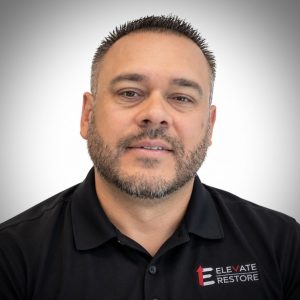
Written by Mike Mendoza, owner and founder of Elevate Restore. Mike started the company in 2010 and still answers billing questions himself. Updated November 2026.
1. Make sure they are insured, and ask to see it
This is the first question, and it is the one most people skip. Restoration crews cut into walls, run equipment and handle your belongings. A company without the right coverage leaves you holding the bill if something goes wrong.
Ask for a certificate of insurance. A real company can send one the same day. General liability and workers’ compensation are the baseline; any legitimate company carries both. Beyond those, two kinds of coverage matter in this trade: pollution coverage, which applies to mold, sewage and contaminated water, and bailee’s coverage, which protects your contents while they are in the company’s care. Elevate Restore carries all four and will send the certificates on request.
2. Check the licenses that apply to the work
Water, fire and mold mitigation in Nevada is licensed as a business, not as a construction trade. Elevate Restore holds business licenses with the State of Nevada, Clark County, and the cities of Las Vegas, North Las Vegas and Henderson. A Nevada State Contractors Board license is required for rebuilding, which is why you should ask any company that offers to “do it all” which part of the job their contractor’s license actually covers. We do not rebuild; we refer that work to contractors we have worked with for years.
3. Ask whether they are an IICRC Certified Firm
The IICRC (Institute of Inspection, Cleaning and Restoration Certification) sets the standards the insurance industry uses for drying, mold remediation and fire cleanup. Individual technicians can hold IICRC certifications; a Certified Firm is a company that has committed to those standards as a business. Elevate Restore is an IICRC Certified Firm. If a company says “certified” without saying by whom, ask.
4. Understand how the pricing works before anyone starts
There are three ways restoration work gets priced, and you should know which one applies to you.
- Insurance claims are priced in Xactimate, the estimating system insurers themselves use. Every line is a standard item: a day of a dehumidifier, a square foot of drywall removed, an hour of labor. Your adjuster can read it line by line, which is the point.
- Self-pay jobs should get a written estimate up front, before work begins. Ours come from our own price list. One honest caveat: mitigation is harder to estimate than most trades. The full extent of water damage is sometimes not visible until walls or flooring are opened, and dry times vary because different materials dry at different rates. A good company tells you that before you sign, explains what could change the number, and tells you before it changes.
- Commercial work is usually time and materials against a published price list, so the property manager or property owner can audit it. Time and materials is fair, but it leaves one big question open: are you paying for a $7,000 job or a $70,000 job? That is why, on large commercial losses, we work to give you a not-to-exceed figure within 24 to 72 hours, depending on how complex the loss is.
A fair invoice lists the equipment by day, the labor by hour and the materials by quantity, and it matches what you saw happen in your home or business. If an invoice arrives with no quote behind it, or the equipment count does not match what was in the house, ask for the breakdown before paying.
5. Know how the insurance claim will actually work
A good restoration company handles the claim with you, not instead of you. And be clear about one thing: the person who files the claim is our customer. The insurance company is not. We will always do right by the property owner and the property. Here is how it works at Elevate Restore:
- We bill your insurance company directly and keep you copied on everything.
- We provide all of the documentation the claim needs: moisture readings, photos, drying logs and the Xactimate estimate, in the form adjusters expect to see.
- You can also choose to pay directly and be reimbursed by your carrier.
- If a claim is denied or delayed, we offer financing through a third-party lender and, if you would rather not use it, a payment plan with us within reason.
Your deductible is between you and your policy; we do not play games with it. Depending on the situation, we may ask for a deposit before work begins, and you will hear that from us before anyone starts, not on the invoice.
6. Ask what happens in the first hour
Speed is the whole difference between a two-day dry-out and a two-month mold problem. Ask any company what actually happens when you call. At Elevate Restore, a live person answers, 24 hours a day. You are not calling an 800 number and pressing 1 for an emergency, and you are not talking to a recording or an AI chatbot. If you called 911 for an emergency, would you want to talk to an AI? Neither would we. You get an actual person, local to Las Vegas, who takes the details of your loss while we mobilize a crew. Our project manager, or our lead technician if the project manager is already on a job, is dispatched to assess the damage, with the goal of being at your door within an hour anywhere in the Las Vegas Valley. On arrival we walk the damage with you, get the paperwork signed, and start mitigation that same visit.
One more reason the first hour matters: starting mitigation is not optional. It is not a legal liability on you as the owner, but nearly every homeowner’s policy requires you to protect the property from further damage once you know about a loss, and your mortgage company expects the same under your loan. Waiting a few days to “see if it dries out” can give the insurer a reason to reduce or deny the claim. Make the call, get the water stopped and the drying started, and the paperwork can catch up.
7. Ask where their work stops
Mitigation is stopping the damage and drying, cleaning and removing what cannot be saved. Rebuilding is the drywall, paint, cabinets and flooring that come after. Some companies do both; some, like us, do mitigation only and refer the rebuild. Neither is wrong, but you should know before you sign who is doing which part and who to call if the two do not line up. Because we have been doing this since 2010, we keep a referral list of rebuild contractors we trust.
Three questions to ask any restoration company
- Are you insured, and can you send me the certificate today?
- Are you an IICRC Certified Firm?
- How fast can you be here, and what will you do when you arrive?
Then do the one thing nobody asks: look them up. Read the reviews, including the bad ones, and see how the company answered. Ours are not perfect everywhere. We are human, we make mistakes, and the record of how we handle them is part of what you are hiring. We do not run from issues that come up. We have a saying in our company: right is right. It means that when something goes wrong on a job, we fix it because fixing it is the right thing to do, not because someone forced us to and not only when a review is on the line. If you want to know what a company is really like, read what they did after a job went sideways.
If something goes wrong
On insurance jobs, billing questions are almost always settled between us and the carrier, and you will rarely see an invoice at all. On self-pay jobs, you have the quote in hand before we start, so there should be nothing to dispute. If you do have a question about a bill, you can reach me, Mike Mendoza, directly. I own the company, and I have the authority to make it right on the spot. That is not true at every restoration company in Las Vegas, and it is worth asking about before you hire one.
About Elevate Restore
Elevate Restore has served Las Vegas, North Las Vegas, Henderson, Summerlin and the rest of the valley since 2010 with water damage, fire and smoke, and mold restoration. We are an IICRC Certified Firm, we are insured, and the people who answer the phone and run the jobs have mostly been with us for six years or more. Our rule for every job is simple: do the right thing, no matter what. Call (702) 540-2219 any hour, and a live person will answer.
Common questions
Do I have to use the restoration company my insurance company suggests?
No. You can choose any company. Your insurer may recommend one, but the decision is yours.
Will you work with my insurance company?
Yes, all of them. We bill the carrier directly, provide all of the documentation the claim needs, and keep you informed throughout. You are our customer, not the insurance company.
Do you need a contractor’s license to do water damage restoration in Nevada?
Not for mitigation. A State Contractors Board license is required for rebuild work, which is why we refer rebuilds to licensed contractors rather than doing them ourselves.
How quickly can you get here?
Our goal is a technician on site within an hour of your call, anywhere in the Las Vegas Valley, 24 hours a day.
Do I have to start mitigation right away, or can I wait for the adjuster?
Start right away. Your insurance policy requires you to protect the property from further damage, and your mortgage company expects it too. Waiting for the adjuster before drying begins can hurt the claim. Take photos, make the call, and let the adjuster see the damage through the documentation we provide.
What if I cannot afford the work right now?
We offer financing through a third-party lender and in-house payment plans, including when a claim is denied.
More answers on our frequently asked questions page.
Need help now?
Call (702) 540-2219. A live person answers every call, 24 hours a day, not an AI, and we will tell you exactly what happens next.