
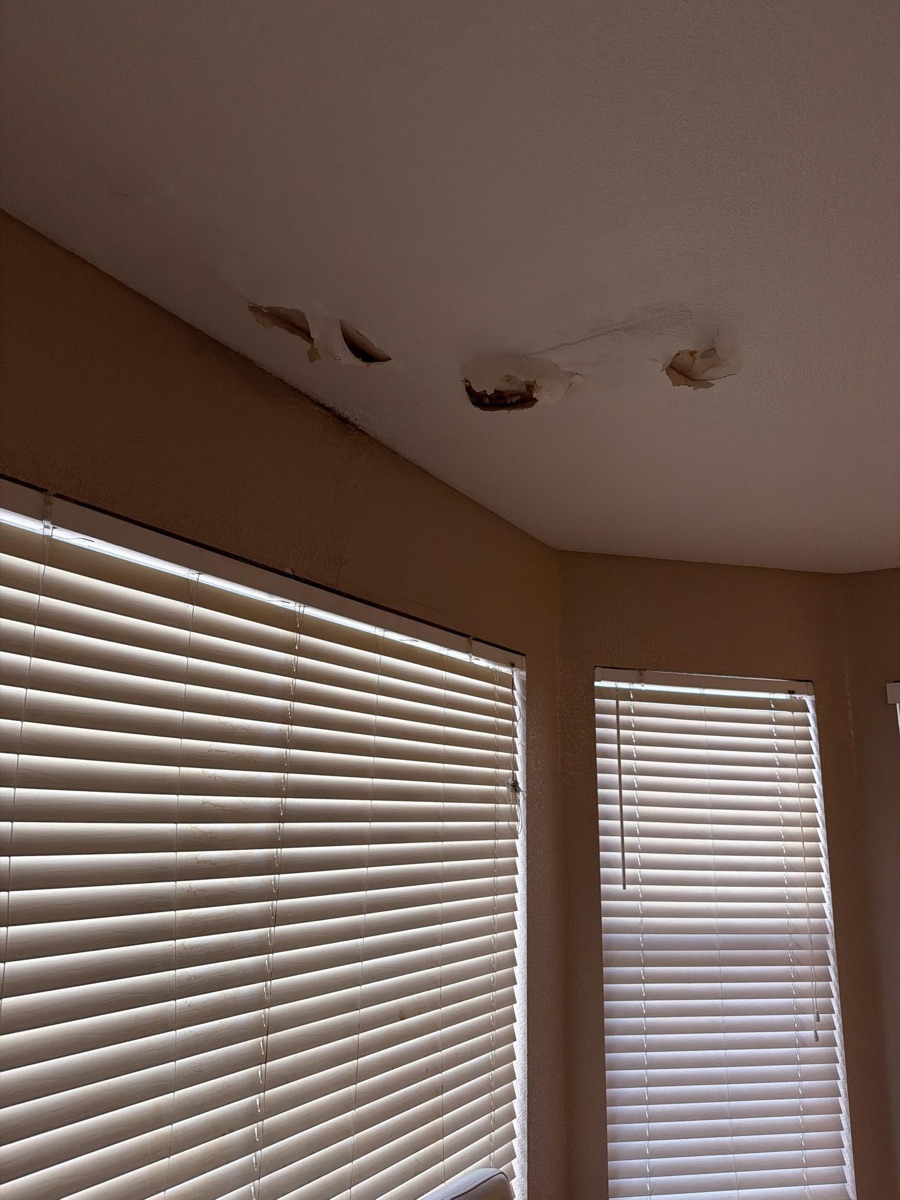
If your ceiling is dripping right now, put a pot or a bucket under it, move anything you care about off the floor, and call us. Do not wait for it to dry on its own. In this town it looks like it dries. It does not. I will explain why below, and what your insurance is and is not going to do about it, because that changed this year.
What the last week looked like from our side
On Friday, October 30, the weather service put the whole valley under a flash flood warning. Henderson got more than three inches of rain in three hours and had three water rescues. Halloween night it came back for the northwest: North Las Vegas, Centennial Hills, Summerlin. That was on top of the tail end of Tropical Storm Rachel in October, which put water on the Strip.
Our phones do the same thing every time it rains here. Calls double. Almost none of them are the dramatic stuff you see on the news. They are roof leaks and ceiling stains, this time mostly on the west and northwest sides of the valley. A brown ring on a bedroom ceiling. A drip over the kitchen. A wet spot in the garage. Small things that people are not sure are worth a call.
They are worth a call. Here is what to do, in order.
The first hour: what you do before anyone arrives
- Put something under the drip. It sounds too simple, but most roof leaks are a steady drip, not a stream, and a bucket keeps the water off your flooring. Floors are where a small leak turns into a big bill.
- Move rugs, furniture and anything electrical away from the wet area.
- Take photos of the ceiling, the floor and anything that got wet, with your phone’s time stamp. You will want them for the insurance company and for us.
- Call us at (702) 540-2219. A live person answers, every hour of the day, and we will tell you what happens next.
What we do when we get there
We are not roofers, and we will say so on the phone. If the roof needs repair, we refer you to a roofer we trust. What we do is the part that stops the damage from spreading inside the house.
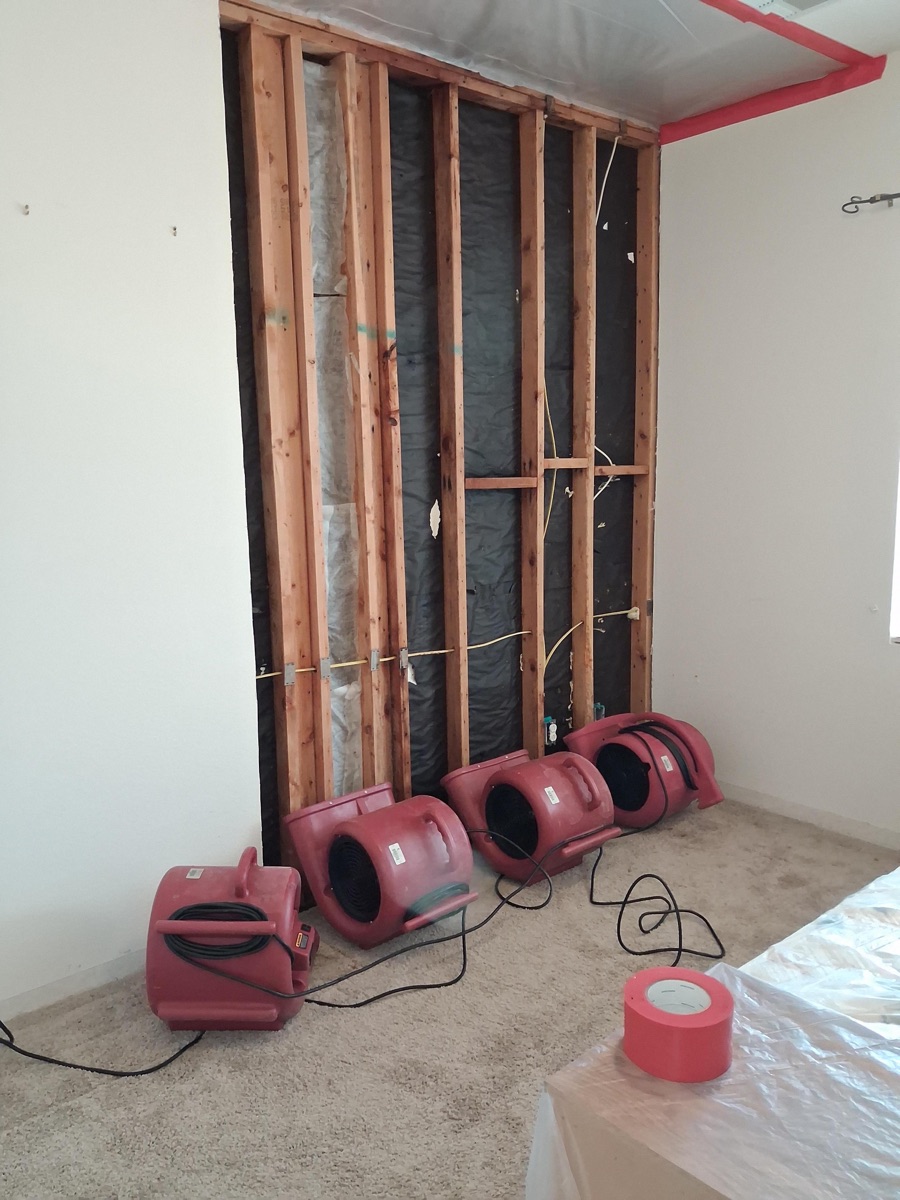
We find how far the water went, which is almost always farther than the stain. We open up the wet drywall so the inside of the wall or ceiling can actually dry, instead of sealing the moisture in where mold grows.
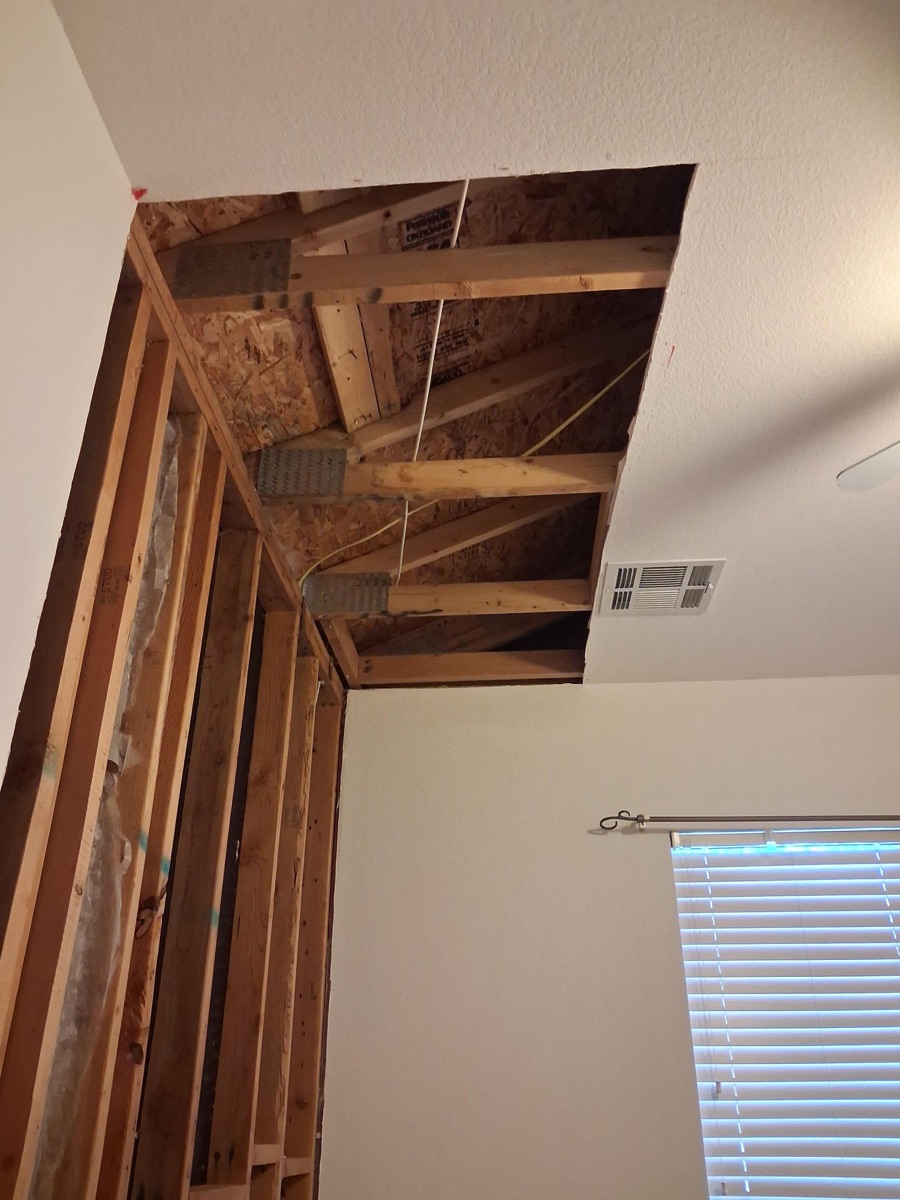
Then we set up drying equipment and check the readings until the structure is dry. On a typical roof leak that is a few days of equipment, not a construction project.
Why it does not just dry out in the desert
This is the part I wish more people believed. Everyone here assumes that because it is Las Vegas, a wet ceiling will dry on its own. The surface does. The inside of the ceiling, the back of the drywall, the insulation sitting on top of it, the framing, does not. It stays damp in the dark, and that is all mold needs.
We know this because of the calls we get afterward. A few weeks, a few months, sometimes a year after a storm, someone calls and says, “I have mold in my house.” When we come out, it is the same ceiling that leaked in the rain. By then it is not a water job anymore. It is a mold job. That means containment, more protective measures, more demolition, and a lot more cost than drying the ceiling would have been the week it happened.
Mold affects people differently. Plenty of homes have a little and nobody notices. We have also worked jobs where someone in the house got sick enough to end up with doctors and hospital visits before anyone found the mold behind a wall. Those are hard jobs to be on. Every one of them started as something small that got left.
What your insurance will and will not cover
I want to be straight about this, because what we are hearing from adjusters this fall is different from what it was a few years ago.
Historically, a roof leak from wind-driven rain has been a covered loss on a normal homeowner’s policy. That is still the general rule: if the wind opened up the roof and rain came in behind it, it is usually covered.
What has changed is the small stuff. Adjusters are telling us that policy wording has tightened, and a small roof leak that is not clearly wind-driven, where the roof just did not hold the water, is increasingly being treated as maintenance and not covered. Every policy is different. Read the water and wind sections of yours, or send them to us and we will read them with you.
The other rule has not changed and it surprises people every storm. If the water came from outside the house at ground level, up a driveway, through a garage, in from the street or a wash, that is flood damage, and a homeowner’s policy does not cover flood. That takes a separate flood policy, which most people in the valley do not carry.
People ask about FEMA. FEMA help for individual homeowners only becomes available after the President declares a major disaster for the county. As I write this, there is no such declaration for these storms. If that changes we will say so here.
So here is my honest advice. Call your insurance company, and call us either way. We document the loss, give you the readings and the photos, and work with the adjuster on what is covered. If it turns out it is not covered, we will tell you what the drying actually costs. For most roof leaks it is a lot less than people fear, and it is a fraction of what the mold job costs later. We also offer financing through outside lenders for exactly this situation.
The one thing I ask
Take care of it now. Not because I want the work. Because the cheapest, safest version of this problem is the one you handle the week it rains. The expensive version is the one you find next summer.
If you have a wet ceiling anywhere in the Las Vegas Valley, Henderson or North Las Vegas, call (702) 540-2219. A live person answers, and our goal is a technician at your door within the hour. More on what we do after a storm is on our storm damage page, and if you are comparing companies, start with how to choose a restoration company.

Written by Mike Mendoza, owner of Elevate Restore. Mike started the company in 2010 and still takes storm calls himself. Elevate Restore is an IICRC Certified Firm. Updated November 2026.
Questions we get after a storm
Will my homeowner’s insurance cover a roof leak from the storm?
Often, if wind opened the roof and the rain came in behind it. Adjusters are telling us that small leaks with no clear wind damage are being treated as maintenance more than they used to be. Read the wind and water sections of your policy, and call us either way. We document the loss for the claim.
Does Elevate Restore fix roofs?
No. We refer you to a roofer we trust for the repair. We handle the inside: opening the wet drywall, drying the structure, and checking that it is dry before it gets closed up.
The ceiling looks dry now. Do I still need to do anything?
Yes. The surface dries fast in the desert. The drywall backing, the insulation and the framing above it do not. The mold calls we get are from leaks that looked dry weeks or months earlier. Drying it the week it happened is a few days of equipment. Finding it next year is a mold job.
What if insurance will not cover it and I cannot pay right now?
Call us anyway. We will tell you what the drying actually costs, which for most roof leaks is far less than people expect, and we offer financing through outside lenders. Waiting is the expensive option.
Water damage in Las Vegas? See our Las Vegas water damage restoration page, or call (702) 540-2219. A live person answers 24/7.
Storm or flood damage at a business? See commercial storm damage restoration and commercial flood damage restoration.